When someone is considering hearing care, they rarely follow a predictable path from their first time seeing an advertisement to scheduling an appointment. That creates a challenge for hearing care organizations: How do you know which marketing efforts are actually contributing to new patients and sales?
Focusing on only the final click or call when trying to attribute a lead leaves out much of the story. Your marketing strategies should work together and be based on data. An omnichannel marketing approach looks at how your marketing channels work together throughout the patient journey and how those interactions result in real outcomes for both you and your patients.
The Hearing Care Patient Journey Isn't a Straight Line
For many prospective hearing care patients, the decision to contact a practice doesn’t happen after a single interaction.
They might receive a direct mail piece for a local practice, then search for that practice online. That same person may also visit the website, read reviews, encounter a digital ad, and eventually schedule an appointment through that ad.
That’s where last-touch attribution can fall short. It credits the final interaction, in this case Google, without necessarily accounting for what prompted the person to start paying attention to your business or brand in the first place.
In hearing care, potential patients can spend weeks or months considering getting treatment or even a specific practice while encountering it through multiple touchpoints. Looking only at what happened immediately before an appointment was made can miss important parts of the patient journey.
How an Omnichannel Approach Connects the Patient Journey
An omnichannel marketing strategy looks at marketing as a connected experience rather than a collection of unrelated campaigns.
For hearing care, that journey may look like:

- Direct mail can introduce a practice or offer to a targeted household.
- Digital advertising can reinforce that message
- Search captures when they begin actively looking for hearing care.
- Reviews can help that person decide which provider to contact.
Each touchpoint can help move a prospective patient closer to taking action, with each channel supporting a different part of the decision-making process. The exact sequence won’t be the same for everyone. The point is to understand how the channels they encounter work together rather than treating each interaction as an isolated event.
What the Data Reveals About Cross-Channel Influence
The value of an omnichannel strategy isn’t simply theoretical. Campaign data can show how activity in one channel relates to activity in another.
Paid Search Performance After a Mail Drop
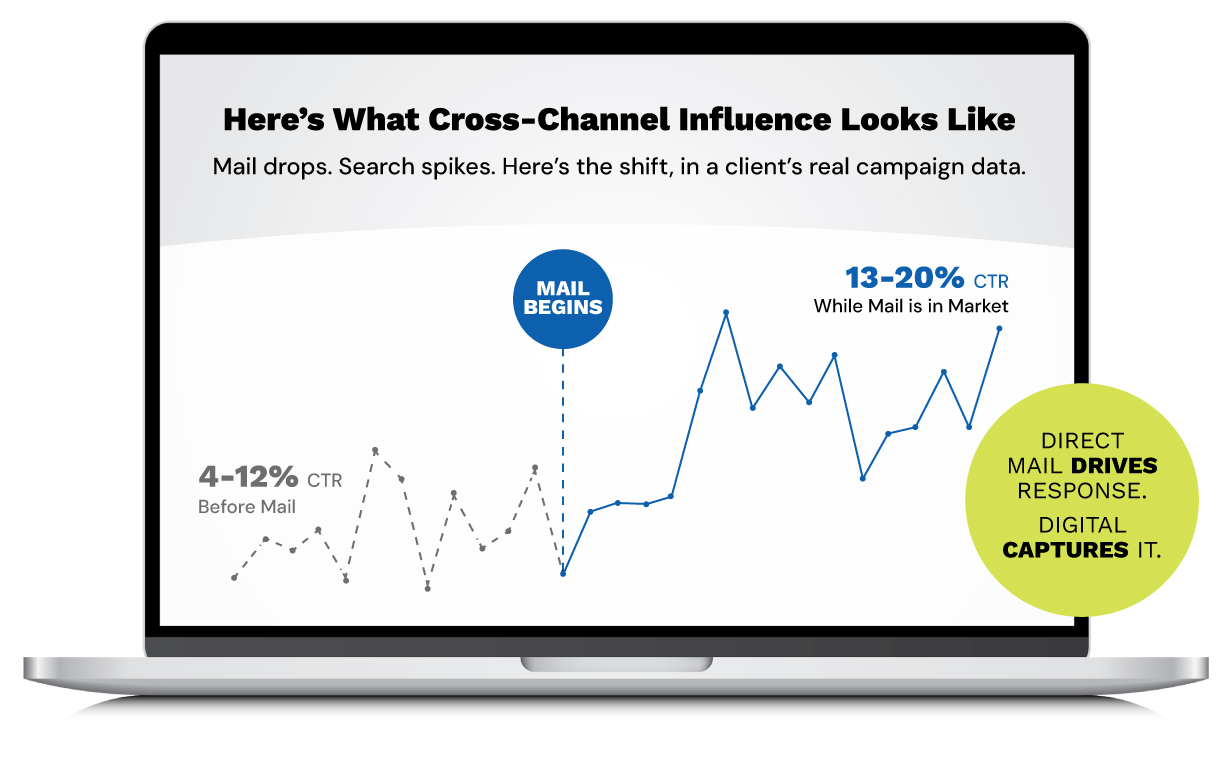
In one campaign run by Darwill, paid search performance for our hearing care client resulted in these changes three days after the mail drop:
- 11% increase in click-through rate,
- 20% increase in conversion rate,
- 10% decrease in cost per lead.
The takeaway isn’t that direct mail automatically produces these results. Rather, it demonstrates why it’s worth looking at what happens across channels.
These numbers suggest that search activity can change after a mail campaign, so it may be worth investigating how those channels are influencing one another. This can be especially useful for hearing aid marketing, since it may take potential patients longer to move from initial awareness to making an appointment.
How Darwill's Data Connects Marketing to Patient Outcomes
We start with identifiable households, then examine what happens after someone is exposed to a campaign. With the help of CRM and practice management data, it becomes possible to see more of the patient journey, not just if someone clicked or responded, but whether that interaction eventually led to an appointment or a new patient.

From Campaign Exposure to Patient Outcomes
Clicks and calls can show whether people are responding to a campaign, but they’re not the final measure of if it was a success.
The more important questions are what happens afterward:
- Did the person schedule an appointment?
- Did they become a patient?
- Did that patient eventually purchase hearing aids?
By connecting campaign exposure with available patient data, we can evaluate which audiences and campaigns are moving people further through the patient journey.
How Matchback Helps Fill Attribution Gaps
Matchbacks can help connect those pieces when a patient’s final interaction doesn’t tell the whole story.
Consider the example we gave earlier: a household receives a direct mail piece, searches for the practice online, and then calls through the practice’s Google Business Profile.
We already know that last-touch attribution will give Google all the credit.
A matchback analysis would show that this household also received the mail campaign. This provides additional context about what happened before that final interaction. The end goal is to understand the combination of marketing channels that helped move someone toward becoming a patient.
From Marketing Metrics to Meaningful Patient Outcomes
Clicks, impressions, calls, and leads still have value. They can show whether people are noticing and interacting with a campaign.
But for a hearing care organization, those metrics are only part of the picture. Darwill’s framework encourages these businesses to consider these broader-view questions:
- Which audiences are becoming patients?
- Which campaigns generate appointments and sales?
- How long does conversion take?
- Which markets respond differently?
- How does direct mail influence digital activity?
- Which combination of channels produces the strongest return?
These questions shift the focus from individual interactions toward outcomes.
A campaign that generates a large number of clicks may appear successful. However, if another campaign generates fewer clicks but contributes to more appointments or new patients, the second campaign may ultimately be more valuable to the practice.
Using Omnichannel Insights For Better Hearing Care Marketing Strategies
An omnichannel marketing strategy doesn’t mean adding as many channels as possible. It means being intentional about how the channels you’re already using support one another, or how adding one can change your entire strategy.
A practical hearing care marketing strategy starts with five considerations:
- Reach the right audience.
Start with audiences more likely to need hearing care, rather than trying to maximize reach. - Make channels reinforce one another.
Consider how direct mail, search, and digital advertising support the same message and patient journey. - Look beyond the initial response.
Evaluate what happens after the initial click or call, including appointments and new patients. - Connect marketing and patient data.
Connect data sources to get a clearer view of the outcomes. - Use the findings to refine future campaigns.
Identify which audiences, campaigns, markets, and channels are producing meaningful results, and use those insights to inform future marketing decisions.
The Future of Hearing Care Marketing Is Connected
Hearing care organizations don’t have to choose between offline and digital marketing.
Patients already move between them naturally, and your marketing strategy should reflect that. By connecting campaign exposure with engagement, appointments, patients, and sales, organizations can get a clearer picture of what is driving their growth.
That means using data to understand the relationship between marketing activity and patient outcomes. Darwill uses this more connected approach to hearing care marketing. We want to help organizations focus less on assigning credit and more on understanding what actually helps create patients.